


























UAE conditions speed up wear and ageing. Hot asphalt softens rubber and increases scrubbing, UV light dries out sidewalls on cars parked outdoors, and sand and gravel shoulders cut tread blocks. A maintenance routine adjusted for heat is the cheapest way to avoid early replacement and roadside blowouts.
Check pressure monthly and before long trips
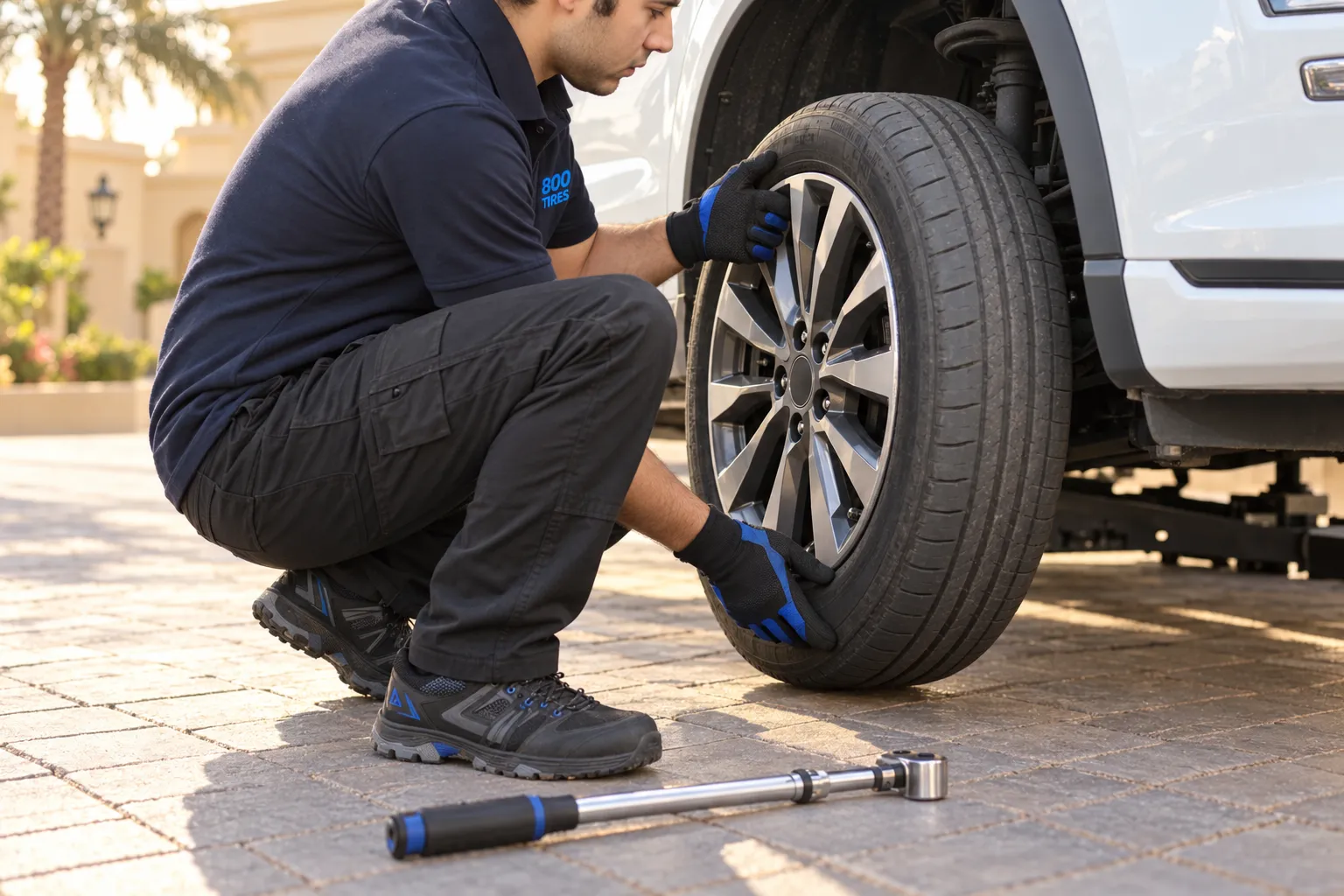
Tyres lose around 1–2 PSI a month through the rubber even with no puncture, so pressure is the most important maintenance task. Check it when the car has been parked for at least three hours or driven less than a couple of kilometres, and set it to the door placard value rather than the maximum printed on the sidewall.
In the UAE, pressure readings swing with the weather. A tyre set correctly in a cool January morning can be several PSI low by an August afternoon reading taken in the same conditions, and the reverse is true going into winter. Checking at the start of each season, and before any long drive to Fujairah, Oman or Saudi Arabia, catches these drifts before they cause wear or heat damage.
- Use the door placard pressure, measured cold
- Check the spare as well; space-saver spares often need about 60 PSI
- Add 2–4 PSI only if the manual gives a higher figure for full load or high speed
- A TPMS warning means check immediately, not at the next service
Rotate tyres every 8,000–10,000 km
Rotating tyres every 8,000–10,000 km evens out wear so all four reach the end of their life together. Front tyres on a front-wheel-drive car do the steering, most of the braking and all of the driving, so they wear much faster than the rears. Without rotation, a front pair can be finished at 30,000 km while the rears still have half their tread.
The pattern depends on the car and tyre. Front-wheel-drive cars usually move fronts straight back and rears crossed forward. Rear-wheel and four-wheel-drive cars do the opposite. Directional tyres can only move front to back on the same side, and staggered setups with different front and rear sizes cannot be rotated between axles at all. A convenient routine is to rotate at every oil service.
- Front-wheel drive: fronts straight back, rears crossed to the front
- Rear-wheel and four-wheel drive: rears straight forward, fronts crossed to the rear
- Directional tyres: same side only
- Full-size matching spare can join a five-tyre rotation on many 4x4s
| Task | How often | Why it matters |
|---|---|---|
| Pressure check | Monthly, weekly in summer | Prevents heat build-up, uneven wear and fuel waste |
| Tread and sidewall inspection | Every 2–4 weeks | Catches nails, bulges, cracks and worn tread early |
| Rotation | 8,000–10,000 km | Evens wear so all four tyres last longer |
| Balancing | Each fitting or when vibration appears | Stops vibration and cupped wear |
| Alignment | Yearly and after impacts | Prevents edge wear and pulling |
| Age check | Yearly after five years from DOT date | Aged rubber cracks and can fail inspection |
Check wheel alignment yearly or after any impact
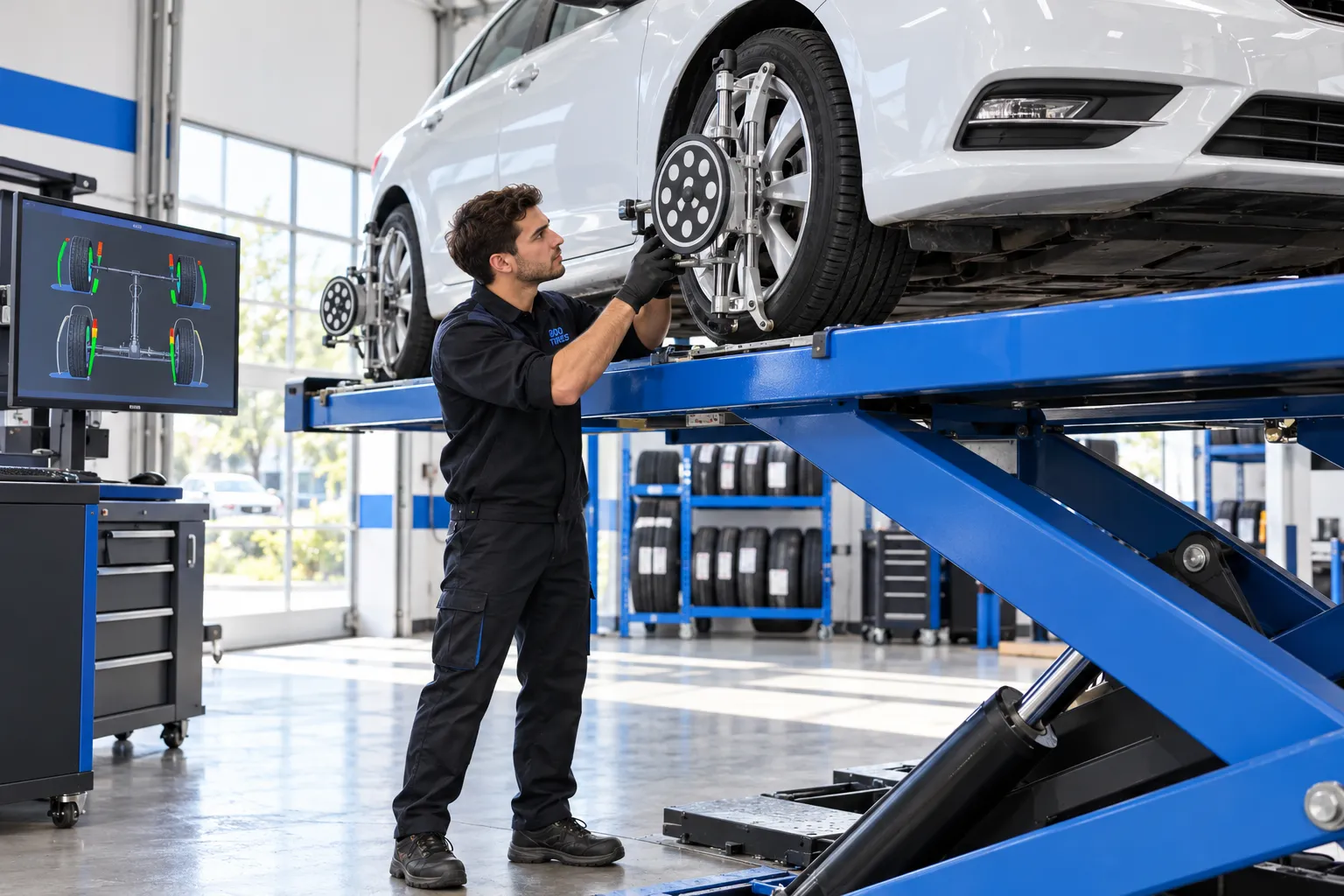
Misalignment is the most common cause of uneven tyre wear, and it can destroy a new tyre's inner edge in a few thousand kilometres. Alignment sets the toe, camber and caster angles of each wheel. A single hard hit on a kerb, a deep pothole or a speed bump taken too fast can move these angles out of specification.
Have it checked once a year, whenever new tyres are fitted, after suspension or steering work, and immediately after an impact. Signs include the steering wheel sitting off-centre when driving straight, the car pulling to one side on a flat road, and wear concentrated on one edge of a tyre. Alignment needs a fixed workshop rig, so it is done at a workshop rather than at the roadside.
Balance wheels whenever a tyre is fitted
Wheel balancing corrects uneven weight around the wheel and tyre, which otherwise causes vibration that typically appears between 80 and 120 km/h. Small weights, often just 10–60 grams, are clipped or stuck to the rim to cancel the heavy spot.
Balance is needed every time a tyre is mounted, after a puncture repair that involves removing the tyre, and whenever a weight falls off, which happens more often than people think on cars driven through car washes and over rough service roads. An unbalanced wheel does more than shake the steering; it hammers the tyre on every rotation, causing cupped wear and loading suspension bushes and wheel bearings.
Inspect tread depth and sidewalls every few weeks
A two-minute walk around the car catches most tyre problems before they become dangerous. Look at the tread wear indicators, the small raised bars inside the main grooves; when the tread is level with them, the tyre is at the 1.6 mm legal limit. A tread depth gauge costs very little and gives an exact reading across the inner, centre and outer grooves.
On the sidewalls, look for bulges, cuts, exposed cords and fine cracks. A bulge means internal cords have broken, usually from an impact, and the tyre must be replaced. Cracks between the tread blocks or around the sidewall show the rubber is drying out with age and heat. Also look for nails, screws and stones lodged in the grooves.
- Measure tread in three places across the tyre, not just the centre
- Plan replacement at about 3 mm; the legal limit is 1.6 mm
- Any sidewall bulge: stop using the tyre
- Read wear patterns: edges, centre or one side each point to a different cause
Adjust care for UAE heat and sand
Heat is the main enemy of tyres in the UAE; summer asphalt at 60–70°C and parked cars in direct sun age rubber far faster than temperate climates. Tyre makers rate compounds for heat, but the casing still degrades with every cycle of heating and cooling.
Park in shade or covered parking where possible, check pressure more often between June and September, and keep speeds sensible on long midday highway drives with a fully loaded car. After desert trips, check the tyres for cuts from rocks and make sure pressure has been restored to the road value. Rinse sand and salt from wheels so that valve stems and TPMS sensors do not corrode.
A simple maintenance calendar
The easiest way to stay on top of tyres is to tie each task to something you already do. Pressure goes with fuel stops, rotation goes with oil changes, and alignment goes with annual registration renewal, which in the UAE already means an inspection for many cars.
If you drive more than 30,000 km a year, as many E11 commuters between Dubai and Abu Dhabi do, shorten every interval. If the car sits for weeks during summer travel, inflate tyres to the placard value before leaving, park in shade and check them again before the first drive back.
- Every 2–4 weeks: pressure check and visual inspection
- Every 8,000–10,000 km: rotation and balance check
- Every 12 months or 15,000–20,000 km: alignment check
- From five years after the DOT date: yearly professional inspection and plan replacement